
Make a Morse Audio File Someone Else Can Decode
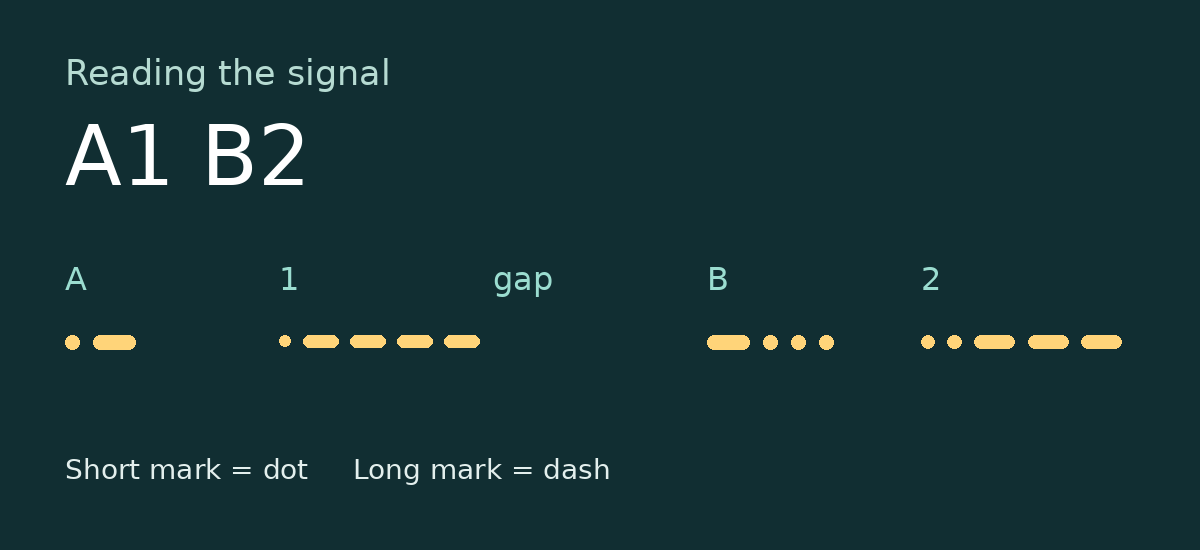
Choose a short test message before exporting your first Morse WAV. A1 B2 exercises letters, digits and a word gap in one file. If a listener recovers all five characters including the space, you have checked more than a single repeated beep.
Export and listen
Enter A1 B2 in the translator, choose a comfortable speed, and play the result once. Download the WAV using the same voice and speed. The file contains sound; the visible slash in the written Morse becomes silence between the words.
Check the received copy
Open the downloaded file in the audio decoder and compare the recovered text with A1 B2. If you plan to share it through a messaging app, send it as a file and check the copy that arrives. Testing the received file tells you whether that particular sharing workflow preserved the recording. A successful result applies to the file you tried.
Play, Pause, and Download WAV sit under the Morse sequence. The download uses the voice, speed, and pitch selected at that moment, and it does not start the speakers. Classic Beep, Guitar, and Violin all keep the same dot, dash, and gap lengths.